

The Buddha said: “To keep the body in good health is a duty … otherwise we shall not be able to keep our mind strong and clear.”
You guys know that I am always grateful for my health, especially in a time like this. While things are slowly getting back to normal, COVID-19 is still very much a presence in the world, and people are still at risk.
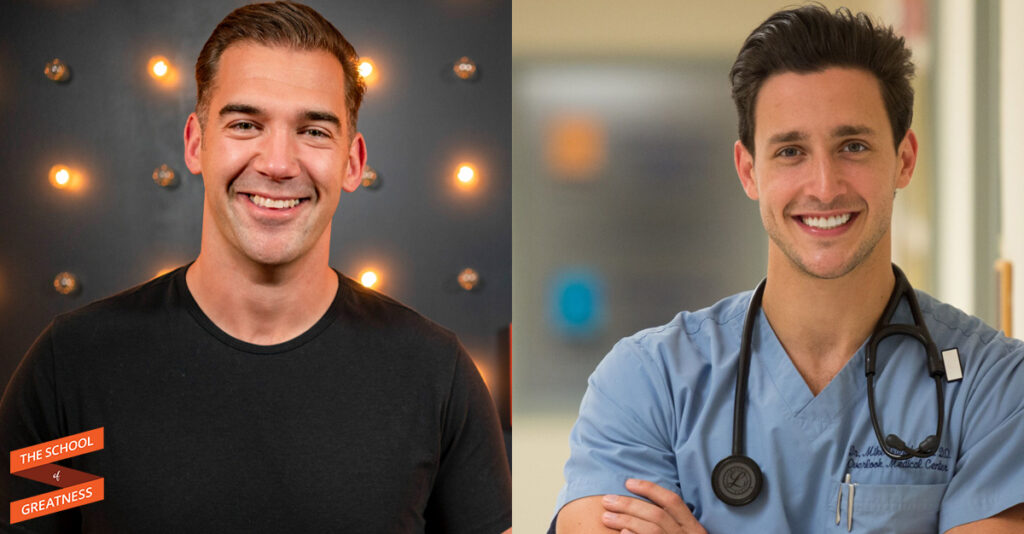
In times of health crisis, we often turn to the internet to give us fast answers. And while some sources are certainly credible, others provide false information. And while it might have a catchy, clickbait-y title, false information can often be very harmful to your body. In the worst cases, bad online health tips have fatal consequences. My guest today is aware of this and is doing his part in educating the masses on what’s really true about their health:
“The absence of quality evidence-based physicians [and], the fear of being labeled ‘unprofessional’ has really allowed for misinformation to rise, and social media to become a misinformation superhighway.” – Dr. Mike
That being said, there are things you can do at home to improve your health. On The School of Greatness, I am all about giving you trusted information from the experts. On my last episode, I interviewed Dr. Rhonda Patrick, and we talked about the different foods, exercises, and vitamins you should prioritize to live a full, healthy life.
Today, we’re going to continue that conversation with Dr. Mike and talk about the things we can all be doing to take better care of our health. We’re going to dive deep into the power of the mind-body connection and discover how your physical health affects your mental health and vice versa. Then, we’re going to discuss some simple things we can all be doing to be proactive about our health.
We’re also going to talk through some popular health myths and discover how we can find the best information out there. And finally, we’re talking through some practical health tips I think we could all use in the midst of this pandemic. This episode has a ton of great information, guys, so let’s dive in!
Who Is Dr. Mike?
Dr. Mike is a board-certified family medicine doctor practicing in the New York City area. He’s also a social media superstar, with more than 10 million followers and half a BILLION YouTube views. Dr. Mike’s mission is to serve and educate people, to dispel medical myths, and help people live healthy, happy lives. And in the process, he’s managed to crack the code for making health information entertaining.
“… Sometimes it means not even making medical content or at least not fully mounted. Like playing a Sims game and creating a medical character in it. You would think, ‘Why would a doctor do that?’ Well, guess what? Now all these young folks who play Sims watch that video and then get recommended the truth about COVID, and they’re able to educate themselves.” – Dr. Mike
Dr. Mike is committed to giving you verified information and debunking health myths we see every day on the internet, and right now, during this global pandemic, there is a huge amount of information out there that is misleading. We need educated and good-hearted people like Dr. Mike to help us navigate through these times, and I’m so excited for you to learn from him today!
Please share any new insight that you learn from this interview on health with your friends, family, and social media network! We got to get the good information out there, people!
The “MindBody” Connection
One of the main things I wanted to talk to Dr. Mike about today was the importance of our mental health. It’s no secret that we’re living in a time of uncertainty, fear, and a lot of extra stress on our minds. I wanted to know how we can do a better job of taking care of ourselves! I asked Dr. Mike whether it’s better to try a holistic approach of healing the emotions to heal the body or if it’s all about medication, and he had some wise words to share:
“It’s mindbody. There’s no distinction between the two — It’s not mind and body, it’s not mind dash body, it’s mindbody. And the reason for that is we’re learning more and more that there’s this intimate connection that exists, that if you disrupt something in your physical system, it’s going to travel back to the health system.” – Dr. Mike
Our bodies and our minds are deeply connected — there’s no separating them. That means that when we put a lot of physical strain on our bodies, we’ll end up taking a toll on our emotions. And it works in reverse too — if we’re putting a lot of extra stress on our minds and our emotions, we’re eventually going to start seeing some physical problems.
“So how you feel in a given moment may not have a huge role as to how your physical health is. But if you’re constantly depressed, you’re constantly on edge and nervous and living in a society full of fear, … that will show physical implications over the long term, not just because of the neurological system, but also from the endocrine system.” – Dr. Mike
That means that our emotions can actually affect the ways our brains and hormones work. If we’re depressed, anxious, and afraid for an extended period of time, those negative emotions can start to have a negative effect on our bodies. Doctors like Dr. Mike see a whole range of serious physical health problems that result from long-term disruptions in our mental health. We’ve got to figure out a way to take better care of our emotions.
Top Health Tips from Dr. Mike
With such a strong connection between our mental health and our physical health, it’s really no surprise that the number one thing Dr. Mike thinks we all need is therapy.
“I think we all need therapy. … The form of therapy that I’m actually recommending is called cognitive-behavioral therapy. And it’s the modern form of therapy that has the greatest evidence behind it. … The whole premise behind cognitive-behavioral therapy, which we call CBT, is we, as humans are prone to irrational thinking — we call these … cognitive distortions. … [We] replace [cognitive distortions] with a rational alternative that may not completely replace their irrational thought, but it’ll take the power away, which will decrease anxiety symptoms [and] decrease depressive symptoms.” – Dr. Mike
Therapy can help everyone. Even if you don’t have a specific mental illness, therapy can help you work through your negative thoughts and limiting beliefs — and that’s valuable for all of us.
Those “cognitive distortions” Dr. Mike talked about aren’t just symptoms of depression or anxiety — many of us have them. Dr. Mike said that examples of cognitive distortions are thoughts like “I didn’t get a perfect grade on this test, so I’m never going to succeed.” It’s an “all-or-nothing” mentality that causes you to put way too much pressure on yourself. Therapy can help us all overcome that kind of thinking and develop healthier thought patterns.
But for some people, the thought of scheduling an appointment with a mental health professional is overwhelming. I get it — It can be scary to ask for help with your mental health! I asked Dr. Mike what a simple first-step could be, and he said that developing a relationship with a primary care physician is essential.
“I love [it] when people have a good primary care provider because good psychological health begins there.” – Dr. Mike
Remember what Dr. Mike said earlier? It’s “mindbody” not “mind and body.” The first step to taking care of your mind can be taking care of your body, and finding a good primary care physician is the perfect way to do that. If you haven’t scheduled an appointment with your doctor in a while, it’s probably a good time to check in with them.
And by the way, Dr. Mike says that it really is best to have a physical with your doctor at least once a year! It’s important to check in and make sure you’re taking good care of your physical and mental health.